
Metrics and curation
In the app
Section titled “In the app”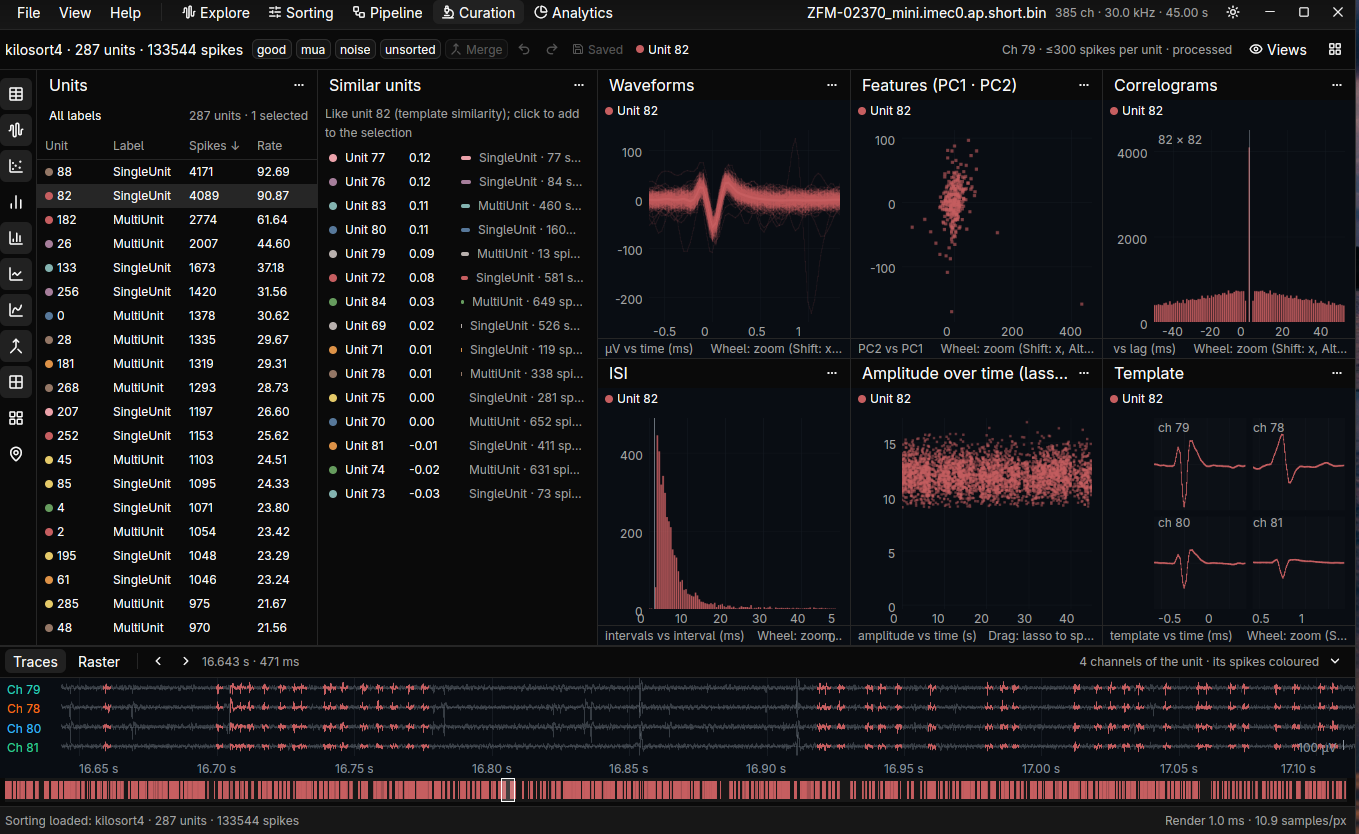
Curation shows the active view’s sorting in views you arrange: each is a dock panel you can drag, snap or close. The Views menu toggles each one, and the Layout menu applies a grid.
| View | Shows |
|---|---|
| Unit table | Sort by any column, filter by label |
| Waveforms | The selected units’ waveforms |
| Features | PC1 against PC2 |
| Correlograms | Auto-correlogram, and cross-correlograms between selected units |
| ISI | Inter-spike intervals |
| Amplitude | Amplitude over time |
| Template | The lead unit’s template |
| Similarity | The units most like it: merge candidates |
| Probe | Units on the probe |
Under them, the bottom strip shows the lead unit’s channels over the shared timeline, or a raster.
Charts are interactive: wheel zooms (Shift for x, Alt for y), drag pans, and double-click resets. Each has its settings under ⋯.
| Action | Keys |
|---|---|
| Label good / mua / noise | Alt+G / Alt+M / Alt+N |
| Merge the selected units | G |
| Split | Lasso on the features or amplitude view |
| Undo / redo | Ctrl+Z / Ctrl+Shift+Z |
| Save | Ctrl+S |
Edits are saved as a log, curation.json, inside the .sorting.zarr, applied on read. The sorter’s
arrays are never rewritten.
From Python
Section titled “From Python”dspk.synapse.metrics has the analyses.
Defaults follow SpikeInterface or the cited papers.
| Question | Function |
|---|---|
| Is the unit refractory? | isi_violations (Hill et al., 2011), llobet_contamination (Llobet et al., 2022), acg_refractory |
| Is it present throughout? | presence_ratio, firing_range |
| Are spikes missed? | amplitude_cutoff |
| Is it well separated? | silhouette, isolation_distance, d_prime, snr |
| A single score | composite_score (EMUsort’s) |
| Should two units merge? | ccg_refractory, suggest_merges |
| Do two sortings agree? | compare_trains, compare_sortings |
| Timing | autocorrelogram, crosscorrelogram, firing_rate, bursts, psth, stimulus_average |
sorting = dspk.synapse.io.Sorting.load("sorted")train = sorting.spike_train(3)dspk.synapse.metrics.isi_violations(train, sorting.total_samples, sorting.sample_rate)