
Finding spikes, and scoring what was found
A spike is a brief deflection well beyond the noise. The simplest detector marks every local
minimum below threshold · σ, with σ estimated per channel from the median absolute deviation
(robust to the spikes themselves). Two others look at the shape: NEO (Teager–Kaiser energy,
large where the signal is both big and fast) and a matched filter (correlation with a spike
shape). One spike shows on neighbouring channels, so detections within a radius on the probe
and a fraction of a millisecond are merged (deduplicate).
The synthetic recording knows when each unit fired, so every detector can be scored: a true spike is found when a detection lands within 0.5 ms of it; a detection is false when no true spike is near.
import numpy as np
import dspkfrom dspk.synapse import detection, iofrom plating import signals
s = signals.synthetic(channels=8, seconds=4.0, units=3, rate_hz=15.0, noise_uv=10.0)band = dspk.ops.filter.iir(s.data, s.sample_rate, "bandpass", [300.0, 6000.0])probe = io.Probe.from_positions([[0, 20 * c] for c in range(s.channels)])  # a linear probe, 20 µm pitch
# Where each true spike's trough is (the synthetic places the waveform's centre at spike_samples)offset = int(np.argmin(s.templates[0])) - s.templates.shape[1] // 2truth = np.sort(s.spike_samples.astype(np.int64) + offset)TOL = int(0.5e-3 * s.sample_rate)
def nearest(a: np.ndarray, b: np.ndarray) -> np.ndarray:    """Distance (samples) from each of ``a`` to the nearest of ``b`` (sorted)."""    i = np.searchsorted(b, a)    left, right = b[np.clip(i - 1, 0, b.size - 1)], b[np.clip(i, 0, b.size - 1)]    return np.minimum(np.abs(a - left), np.abs(a - right))
def score(found: np.ndarray) -> tuple[float, float]:    """Recall (true spikes found) and precision (detections that are true)."""    found = np.sort(found.astype(np.int64))    if found.size == 0:        return 0.0, 0.0    return float(np.mean(nearest(truth, found) <= TOL)), float(np.mean(nearest(found, truth) <= TOL))
results = {}for name, found in {    "threshold": detection.threshold(band, s.sample_rate),    "NEO": detection.neo(band, s.sample_rate),    "matched filter": detection.matched_filter(band, s.sample_rate),}.items():    merged = detection.deduplicate(found, probe, s.sample_rate)    results[name] = (found, merged, *score(merged["samples"]))    print(f"{name:15s} {found['samples'].size:5d} crossings → {merged['samples'].size:4d} spikes · recall {results[name][2]:.0%} · precision {results[name][3]:.0%}")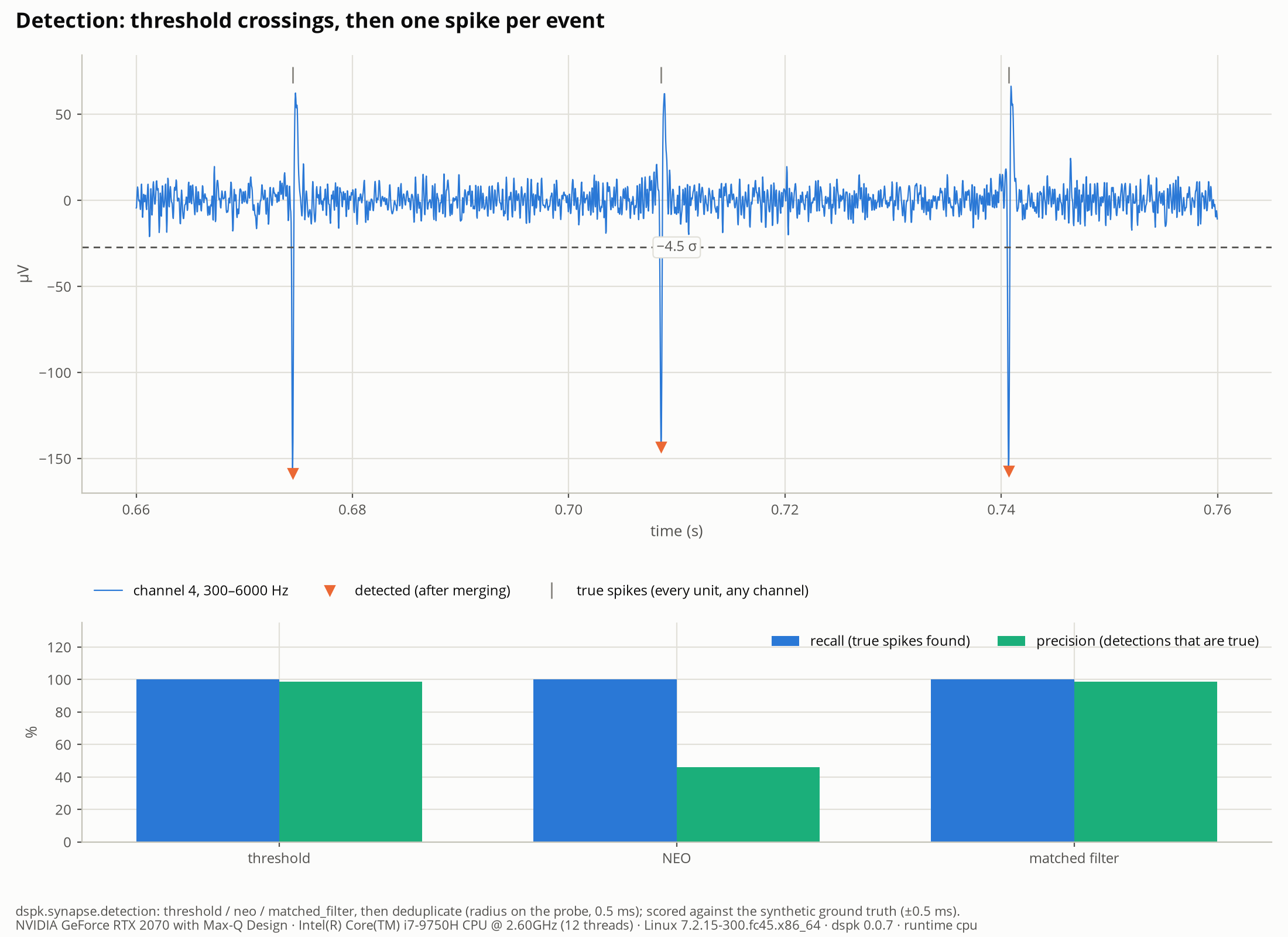
The whole script is playground/08_detection/01_threshold_and_scoring.py. Run it with uv run python playground/08_detection/01_threshold_and_scoring.py.