
From spikes to units: snippets, features, clusters
Each detected spike becomes a snippet: a couple of milliseconds around it, on the channels near it on the probe. Snippets of one unit look alike (same shape, same channels), so they sit together once each is reduced to a few numbers: principal components of the snippets. A clustering of those points proposes the units. Here the truth is known, so the proposal can be checked: each detection is labelled by the true spike it matches.
Two clusterings: k-means (you say how many units) and HDBSCAN (finds dense groups by
itself and calls the rest noise, -1).
import numpy as np
import dspkfrom dspk.synapse import clustering, detection, extraction, iofrom plating import signals
s = signals.synthetic(channels=8, seconds=4.0, units=3, rate_hz=15.0, noise_uv=10.0)band = dspk.ops.filter.iir(s.data, s.sample_rate, "bandpass", [300.0, 6000.0])probe = io.Probe.from_positions([[0, 20 * c] for c in range(s.channels)])spikes = detection.deduplicate(detection.threshold(band, s.sample_rate), probe, s.sample_rate)
# Snippets on every channel (k = all), rows put back in channel order so features line upsnip = extraction.snippets(band, spikes, probe, s.sample_rate, k=s.channels, pre_ms=0.6, post_ms=1.0)order = np.argsort(snip["channels"], axis=1)waves = np.take_along_axis(snip["waveforms"], order[:, :, None], axis=1)  # (spikes, channels, samples)flat = waves.reshape(waves.shape[0], -1)
# Principal components: dspk's PCA takes (dimensions, observations)pca = dspk.ops.linalg.PCA.fit(flat.T, 3)pcs = pca.transform(flat.T).T  # (spikes, 3)print(f"{flat.shape[0]} snippets of {flat.shape[1]} values → 3 PCs ({pca.explained_variance_ratio.sum():.0%} of the variance)")
# The truth of each detection: the unit of the nearest true spikeoffset = int(np.argmin(s.templates[0])) - s.templates.shape[1] // 2truth_t = s.spike_samples.astype(np.int64) + offsett = spikes["samples"][snip["kept"]].astype(np.int64)nearest = np.abs(t[:, None] - truth_t[None, :]).argmin(axis=1)truth = s.spike_units[nearest]
km = clustering.kmeans(pcs, s.params["units"])hd = clustering.hdbscan(pcs, min_cluster_size=10)
def agreement(labels: np.ndarray) -> float:    """Spikes whose cluster's majority unit is their own unit."""    ok = 0    for c in np.unique(labels[labels >= 0]):        members = truth[labels == c]        ok += np.bincount(members).max()    return ok / labels.size
print(f"k-means agreement {agreement(km['labels']):.0%} · HDBSCAN agreement {agreement(hd):.0%} ({np.unique(hd[hd >= 0]).size} clusters, {np.mean(hd < 0):.0%} noise)")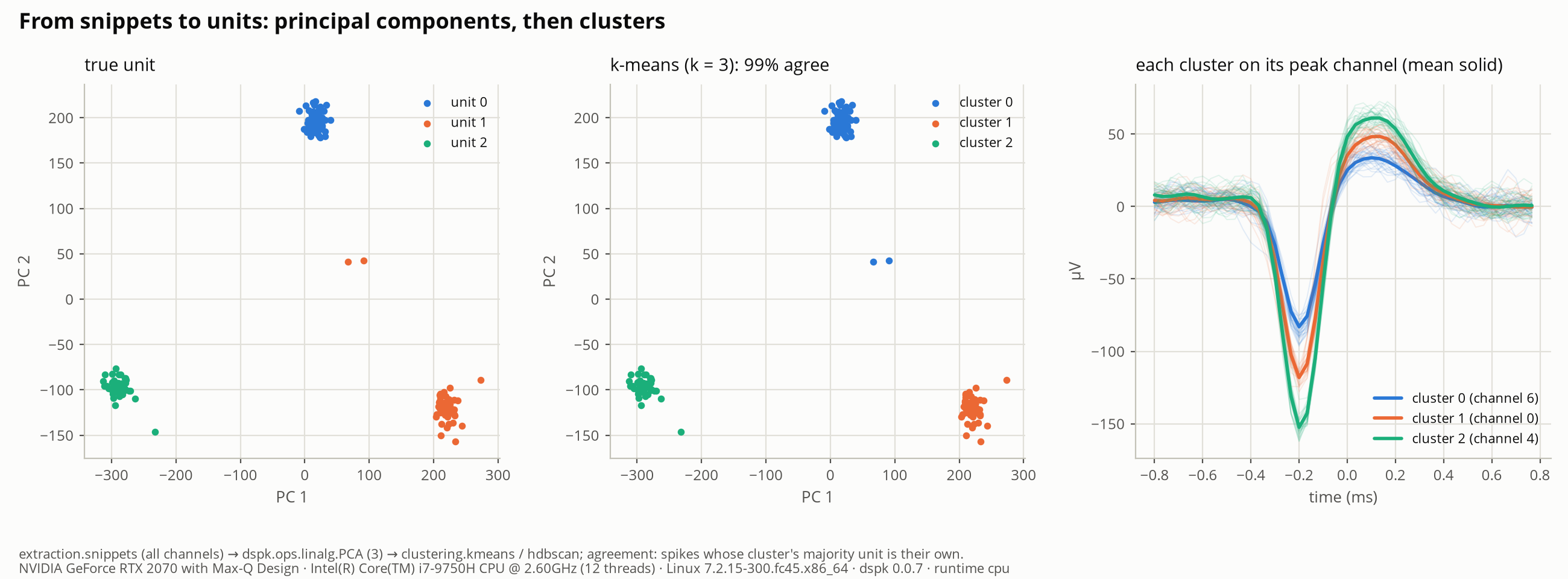
The whole script is playground/08_detection/02_features_and_clusters.py. Run it with uv run python playground/08_detection/02_features_and_clusters.py.