
Templates, and finding every spike again by matching
A cluster’s mean snippet is its unit’s template. With templates in hand, a recording can be searched for them directly: matching pursuit fits, pass after pass, the template (and its amplitude) that explains the most of what is left, and subtracts it. Spikes that overlap in time, which a threshold sees as one, come apart over the passes. Template similarity (cosine at the best lag) shows which units could be one split in two.
import numpy as np
import dspkfrom dspk.synapse import clustering, detection, extraction, io, matchingfrom plating import signals
s = signals.synthetic(channels=8, seconds=4.0, units=3, rate_hz=15.0, noise_uv=10.0)band = dspk.ops.filter.iir(s.data, s.sample_rate, "bandpass", [300.0, 6000.0])probe = io.Probe.from_positions([[0, 20 * c] for c in range(s.channels)])
# Chapter 2 in four lines: detect, snippets on every channel, PCs, k-meansspikes = detection.deduplicate(detection.threshold(band, s.sample_rate), probe, s.sample_rate)snip = extraction.snippets(band, spikes, probe, s.sample_rate, k=s.channels, pre_ms=0.6, post_ms=1.0)waves = np.take_along_axis(snip["waveforms"], np.argsort(snip["channels"], axis=1)[:, :, None], axis=1)flat = waves.reshape(waves.shape[0], -1)labels = clustering.kmeans(dspk.ops.linalg.PCA.fit(flat.T, 3).transform(flat.T).T, 3)["labels"]
# Templates: each cluster's mean snippet, (units, channels, samples)templates = np.stack([waves[labels == c].mean(axis=0) for c in range(3)]).astype(np.float32)similarity = matching.template_similarity(templates)print("template similarity:\n", np.round(similarity, 2))print("merge suggestions (≥ 0.9):", matching.suggest_merges(templates))
found = matching.matching_pursuit(band, templates, min_explained_energy=20_000.0)print(f"matching pursuit: {found['samples'].size} spikes (threshold + merging found {spikes['samples'].size}; truth {s.spike_samples.size})")
# Scored against the truth (±0.5 ms), unit by unit (each template to the true unit it holds most of)offset = int(np.argmin(s.templates[0])) - s.templates.shape[1] // 2truth_t = s.spike_samples.astype(np.int64) + offsettol = int(0.5e-3 * s.sample_rate)for c in range(3):    mine = np.sort(found["samples"][found["units"] == c].astype(np.int64))    near = np.abs(truth_t[:, None] - mine[None, :]).min(axis=1) <= tol if mine.size else np.zeros(truth_t.size, bool)    unit = np.bincount(s.spike_units[near], minlength=3).argmax() if near.any() else -1    recall = np.mean(near[s.spike_units == unit]) if unit >= 0 else 0.0    print(f"template {c} → true unit {unit}: {mine.size} matches, {recall:.0%} of that unit's spikes")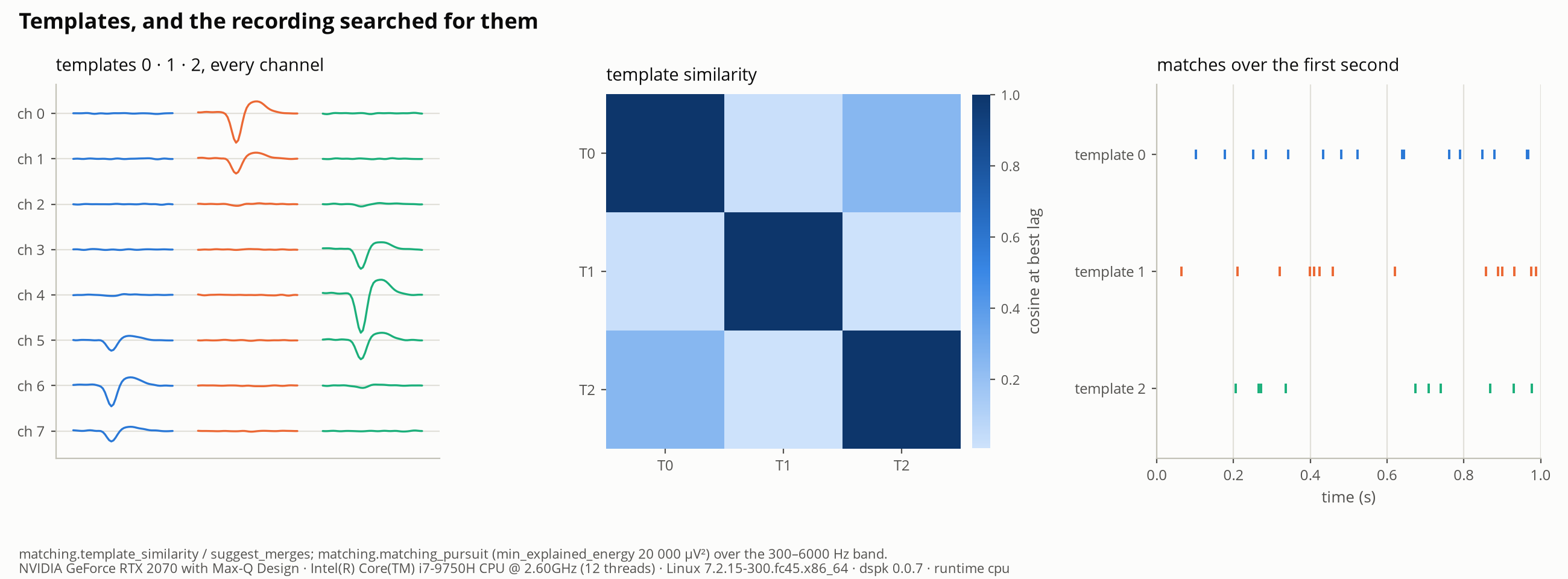
The whole script is playground/08_detection/03_templates_and_matching.py. Run it with uv run python playground/08_detection/03_templates_and_matching.py.