
A chain of stages on the device
Calling dspk.ops functions one after the other moves the data to the device and back at every
step. A dspk.ops.Pipeline keeps it there: one upload, every stage, one download, with filter
designs and device buffers reused from call to call. On a GPU most of a single call’s time is the
transfer, so a chain gains the most.
import time
import numpy as npfrom scipy import signal as sp
import dspkfrom dspk.ops import Pipeline, stagefrom plating import signals
s = signals.synthetic(channels=64, seconds=10.0)BAND = (300.0, 6_000.0)
def one_by_one(x):    y = dspk.ops.filter.notch(x, s.sample_rate, 60.0, 30.0)    y = dspk.ops.filter.iir(y, s.sample_rate, "bandpass", BAND)    return dspk.ops.spatial.cmr(y)
pipe = Pipeline([stage.notch(60.0, 30.0), stage.iir("bandpass", BAND), stage.cmr()], s.sample_rate)sos_notch = sp.tf2sos(*sp.iirnotch(60.0, 30.0, fs=s.sample_rate))sos_band = sp.butter(5, BAND, "bandpass", fs=s.sample_rate, output="sos")
def scipy_chain(x):    pad = dspk.ops.filter.settling_samples    y = sp.sosfiltfilt(sos_notch, x, axis=1, padtype="odd", padlen=pad(sos_notch))    y = sp.sosfiltfilt(sos_band, y, axis=1, padtype="odd", padlen=pad(sos_band))    return y - np.median(y, axis=0, keepdims=True)
def timed(f):    f(s.data)  # warm-up: compiles and tunes the kernels (cached on disk for later runs)    start = time.perf_counter()    out = f(s.data)    return (time.perf_counter() - start) * 1e3, out
cases = {"scipy, on the CPU": timed(scipy_chain), "dspk, one call per stage": timed(one_by_one), "dspk, one Pipeline": timed(pipe.process)}ref = cases["scipy, on the CPU"][1]for name, (ms, out) in cases.items():    print(f"{name:26s} {ms:8.1f} ms   max difference from scipy {np.max(np.abs(out - ref)) / np.max(np.abs(ref)):.1e} of the peak")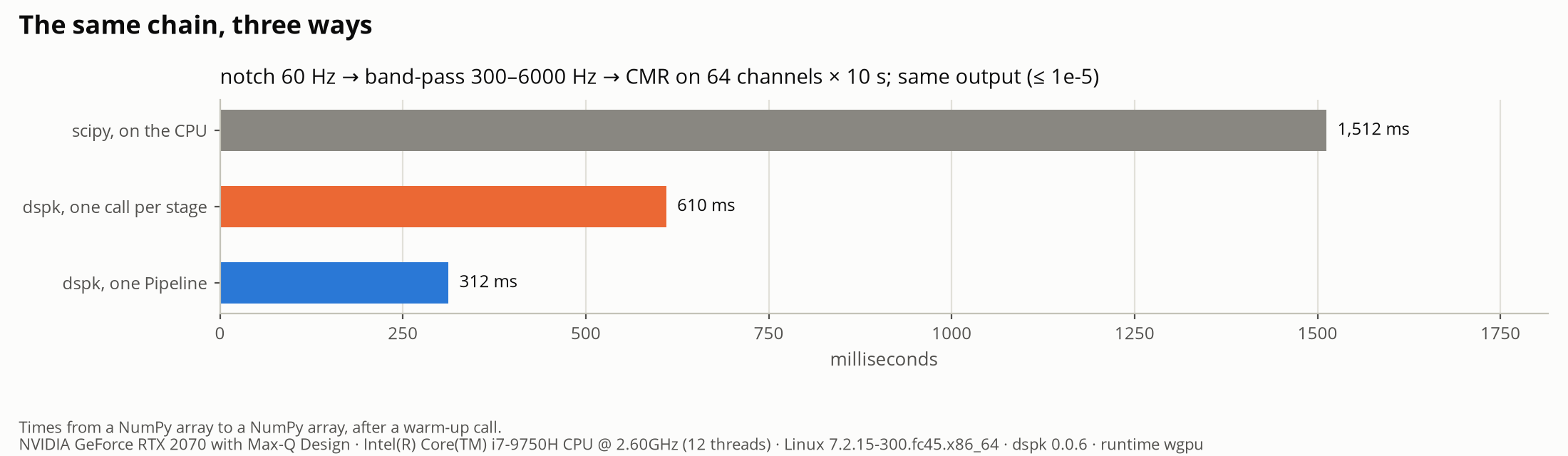
The whole script is playground/06_pipelines/01_chain_on_device.py. Run it with uv run python playground/06_pipelines/01_chain_on_device.py.