
Files in and out
dspk.io.write_raw writes a raw binary with a JSON .meta beside it (any stored type: here
16-bit integers with a gain, as acquisition systems store them); dspk.io.write_zarr writes a
compressed Zarr store. dspk.io.open reads either (and SpikeGLX, NWB) and returns values in their
unit, whatever the stored type.
from pathlib import Pathimport tempfile
import numpy as np
import dspkfrom plating import signals
s = signals.synthetic()work = Path(tempfile.mkdtemp(prefix="dspk-playground-"))
# int16 with a gain of 0.195 µV per step (Intan's), and float32 ZarrGAIN = 0.195dspk.io.write_raw(s.data, work / "recording.bin", s.sample_rate, format="int16", gain=GAIN, unit="µV")dspk.io.write_zarr(s.data, work / "recording.zarr", s.sample_rate, unit="µV")raw, zarr = dspk.io.open(work / "recording.bin"), dspk.io.open(work / "recording.zarr")print(raw)print(zarr)
What comes back: Zarr exactly, int16 within half a step
from_raw, from_zarr = raw.read(), zarr.read()print("zarr max difference:", np.max(np.abs(from_zarr - s.data)))print("int16 max difference:", np.max(np.abs(from_raw - s.data)), f"(half a step: {GAIN / 2:.4f} µV)")assert np.array_equal(from_zarr, s.data) and np.max(np.abs(from_raw - s.data)) <= GAIN / 2 + 1e-4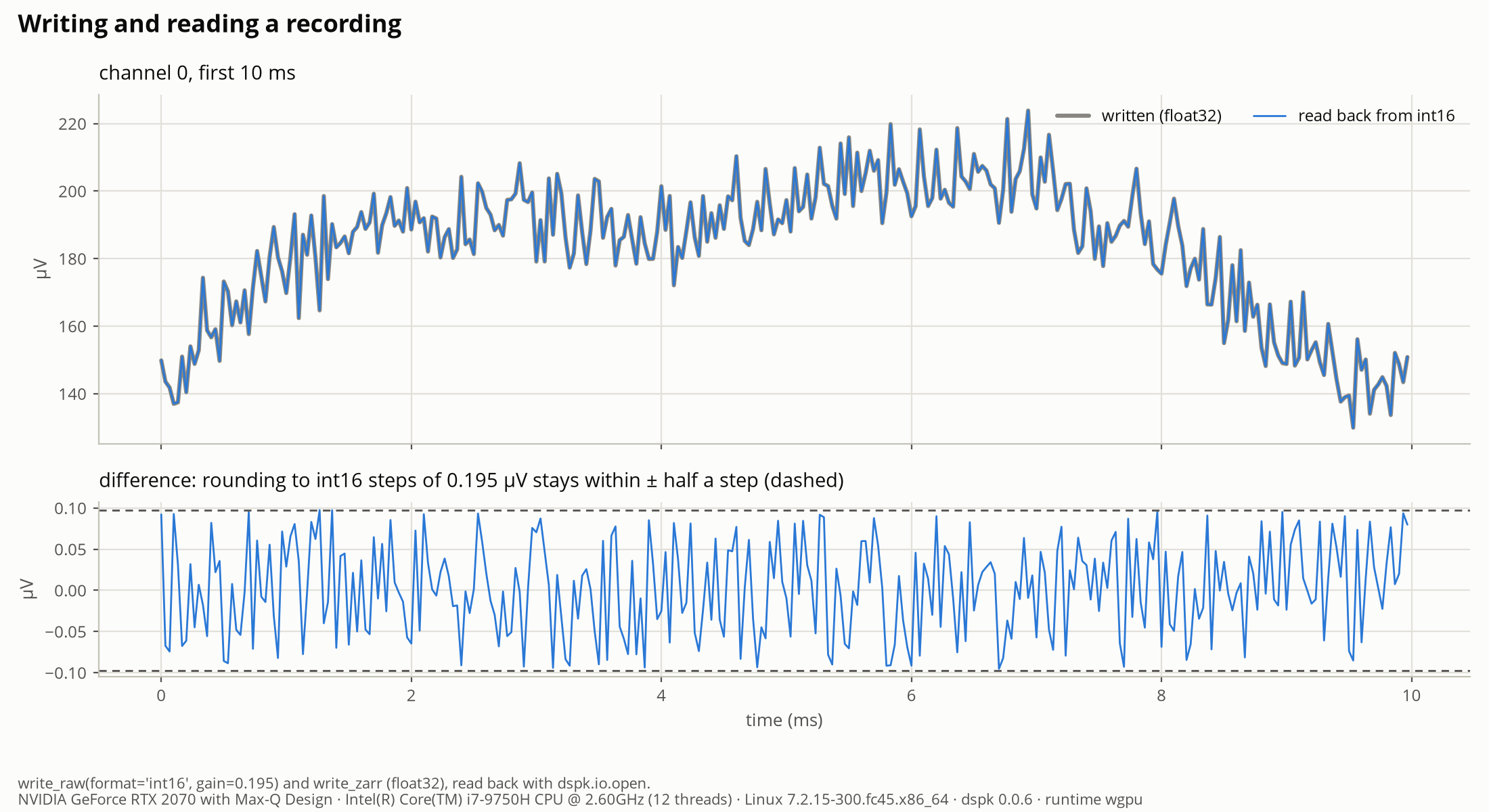
The whole script is playground/01_basics/03_files.py. Run it with uv run python playground/01_basics/03_files.py.