
The synthetic recording
Every chapter up to sorting uses a synthetic recording from plating.signals: its content is
known, so each operation’s effect can be seen and checked. It is the sum of five components,
all kept separately:
| component | what it is | which chapter removes it |
|---|---|---|
lfp |
slow oscillations (4 and 9 Hz) | low-pass keeps it, high-pass removes it (02) |
hum |
60 Hz mains and its third harmonic, the same on every channel | notch (02), referencing (03) |
common |
a slow artefact shared by all channels | referencing (03) |
spikes |
three units firing, each on a few neighbouring channels | what the filters keep |
noise |
white noise, independent per channel | — |
import platingfrom plating import signals
s = signals.synthetic()  # 8 channels × 2 s at 30 kHz, seed 0: the same recording every timeprint(f"{s.channels} channels × {s.samples:,} samples at {s.sample_rate:,.0f} Hz, {s.spike_samples.size} spikes from {len(s.templates)} units")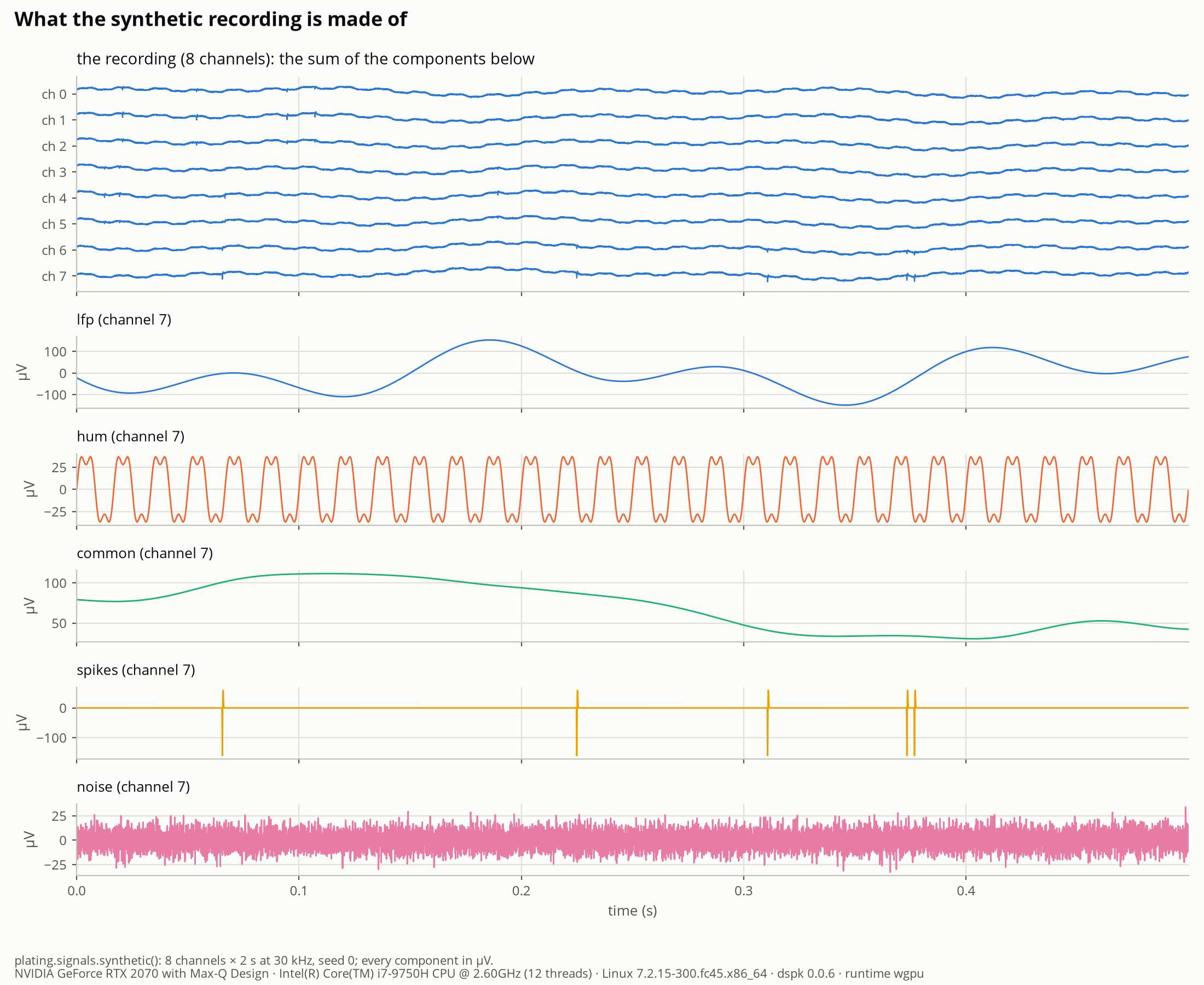
The whole script is playground/01_basics/02_synthetic_signal.py. Run it with uv run python playground/01_basics/02_synthetic_signal.py.