
Recordings saved out of order
Acquisition systems store channels in the order of their amplifier inputs, not the order of the
electrodes, so neighbouring electrodes end up anywhere in the file. A channel map puts them
back, written as pairs (like a hardware channel mapper): “stored channel from is electrode
to”, with an optional name. Inputs left out are dropped; base = 1 reads 1-based numbers
(TDT, MATLAB). Maps are TOML or JSON files ([remap]), and the same file works in Python, in
pipeline specs, in the CLI (--channel-map) and in the app.
from pathlib import Pathimport tempfile
import numpy as np
import dspkfrom dspk.ops import layoutfrom plating import signals
work = Path(tempfile.mkdtemp(prefix="dspk-playground-"))s = signals.synthetic(channels=16, lfp_uv=20.0, spread_channels=1.5)spikes_band = dspk.ops.filter.iir(s.data, s.sample_rate, "highpass", 300.0)
# The amplifier wired electrode e to input wiring[e]: the file stores them in input orderrng = np.random.default_rng(4)wiring = rng.permutation(s.channels)stored = np.empty_like(spikes_band)stored[wiring] = spikes_band
# The map: stored input wiring[e] is electrode e (1-based here, as a TDT export would be)pairs = [{"from": int(wiring[e]) + 1, "to": e + 1, "name": f"E{e + 1:02d}"} for e in range(s.channels)]layout.write_map({"base": 1, "pairs": pairs}, work / "map.toml")print((work / "map.toml").read_text()[:200], "…")
ordered = layout.remap(stored, work / "map.toml")order, names = layout.map_order(work / "map.toml")print("back in electrode order:", np.array_equal(ordered, spikes_band))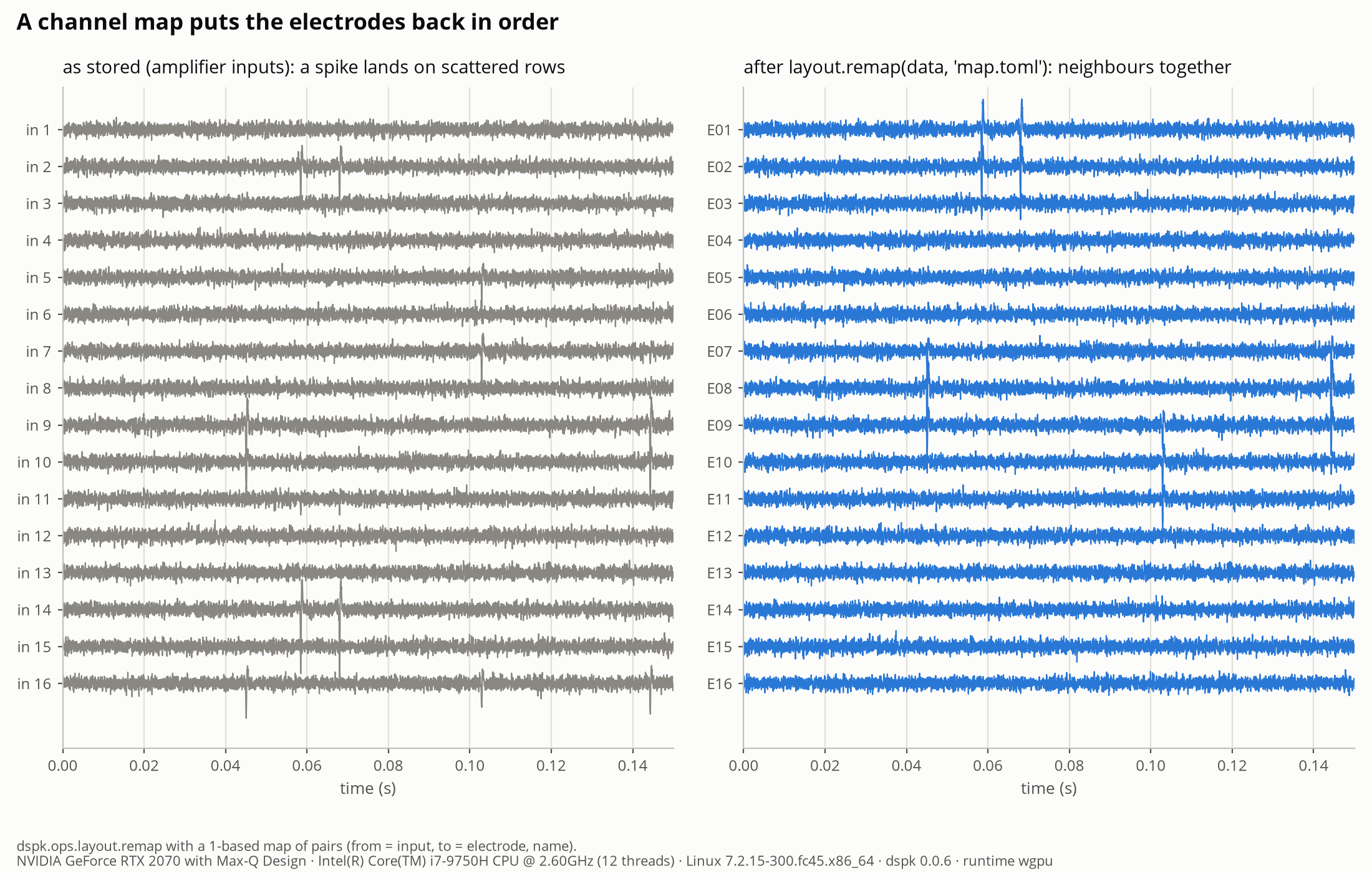
The whole script is playground/07_channels/01_remap_with_pairs.py. Run it with uv run python playground/07_channels/01_remap_with_pairs.py.