
Designing a FIR filter
A FIR filter is a list of taps: each output is their weighted sum of the last inputs. More taps
give a sharper edge between what passes and what is stopped, at the cost of time.
dspk.ops.filter.firwin designs them (a windowed sinc, as scipy’s firwin);
dspk.ops.filter.fir runs them on the device (centered=True: no delay).
import numpy as np
import dspkfrom plating import signals
s = signals.synthetic()CUTOFF = 1_000.0designs = {n: dspk.ops.filter.firwin(n, CUTOFF, sample_rate=s.sample_rate) for n in (31, 101, 301)}
# Frequency response of each design (the Fourier transform of its taps)nfft = 1 << 16freqs = np.fft.rfftfreq(nfft, 1 / s.sample_rate)responses = {n: np.abs(np.fft.rfft(taps, nfft)) for n, taps in designs.items()}for n, r in responses.items():    print(f"{n:4d} taps: gain at {2 * CUTOFF:.0f} Hz {20 * np.log10(r[np.searchsorted(freqs, 2 * CUTOFF)]):6.1f} dB")
# Run the 301-tap design centred (odd length: no delay)out = dspk.ops.filter.fir(s.data, designs[301], centered=True)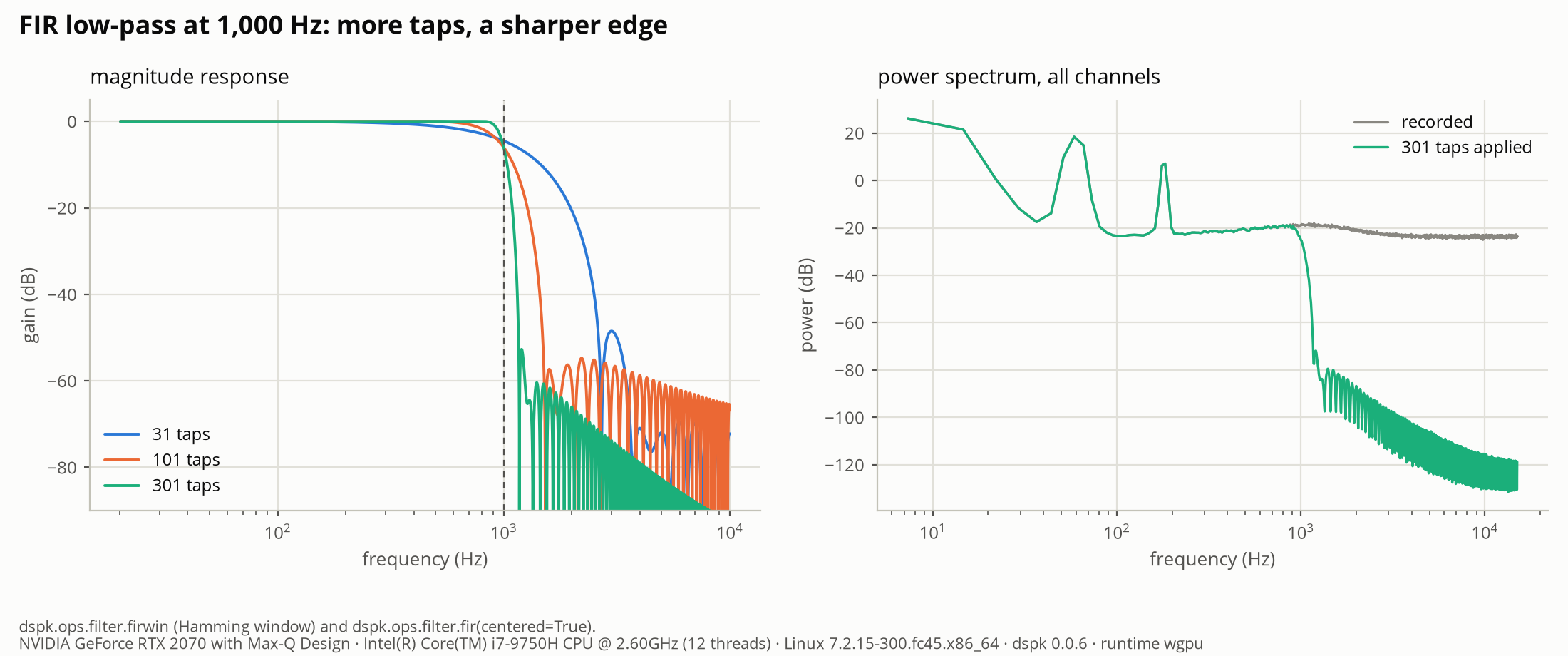
The whole script is playground/02_filtering/04_fir_design.py. Run it with uv run python playground/02_filtering/04_fir_design.py.